Research
Areas of Interest
See this webpage introducing Computational Affective Science (CAS).
Publications for areas marked with a * are interspersed within sentiment analysis and emotion analysis; clicking on them leads to separate dedicated pages that present only the relevant information.
If you are a student interested in working with me, go here.
Online Emotion Analysis and Visualization Tool: The NRC Emotion Viz. Upload your text in this feature-packed online tool and analyze the emotion words in it in seconds.
Data for download (The publication page also provides data associated with individual publications. See terms of use at the bottom of the page.)
Word-association lexicons for sentiment and emotion
(Note: A table summarizing various word-association lexicons can be found here.)
Other lexicons
Annotated Corpora
Other Data
- What Makes Sentences Semantically Related: A Textual Relatedness Dataset and Empirical Study: 5500 English sentence pairs with manually annotated, fine-grained, semantic relatedness scores.
Paper Data
- Data for the NLP Scholar Project: A single unified source of information from both the ACL Anthology (AA) and Google Scholar for tens of thousands of NLP papers.
- PoKi: A Large Dataset of Poems by Children (Paper: pdf)
- SOLO: A Corpus of Tweets for Examining the State of Being Alone
- WordWars: A Dataset to Examine the Natural Selection of Words
- Big Bird: A Large, Fine-Grained, Bigram Relatedness Dataset for Examining Semantic Composition
- Examining Gender and Race Bias in Two Hundred Sentiment Analysis Systems
- WikiArt Emotions: An Annotated Dataset of Emotions Evoked by Art
- A dataset that allows to examine how complex positions on controversial issues are formed by relevant assertions. The data was created by combining qualitative and quantitative surveys.
- Lexical contrast (antonymy) data: includes closest-opposite questions, TURN dataset, LZQZ dataset, different kinds of opposites, lists of automatically generated contrast pairs, etc.
- WordNet verb usages annotated for metaphoricness and literalness, as well as for emotionality.
Information visualization and Data sonification demos
- TransProse: Converting Text to Music. Hannah Davis and Saif M. Mohammad.
A system that takes as input classic English novels and generates music that captures the flow of emotions in it.
- An Interactive Visualizer for the NRC Emotion Lexicon
The NRC Emotion Lexicon is a list of English words and their associations with eight basic emotions (anger, fear, anticipation, trust, surprise, sadness, joy, and disgust) and two sentiments (negative and positive). The annotations were manually done by crowdsourcing.
- Interactive Visualizers for Sentiment Composition Lexicons
Sentiment composition is the determining of sentiment of a multi-word linguistic unit, such as a phrase or a sentence, based on its constituents. We present two visualizations: (1) exploring sentiment composition in phrases formed by at least one positive and at least one negative word- phrases like happy accident and best winter break, and (2) exploring sentiment composition in phrases formed with negators, modals, and degree adverbs.
Systems and Code
- The NRC-Canada sentiment anaysis system.
- The AffectiveTweets Package: Felipe Bravo-Marquez implemented AffectiveTweets for the Weka machine learning workbench that provides a collection of filters for extracting state-of-the-art features from tweets for sentiment classification/regression and other related tasks. The package is especially useful to generate feature vectors from a large number of affect lexicons. The vector can then be concatenated to other features vectors (say dense-distributed representations of the text) to improve perfomance. (You can use the feature vector with any classifier -- not just one with support from Weka.)
- Code to assist with best-worst-scaling annotations. It includes a script to produce 4-tuples with desired term distributions, a script to produce real-valued scores from best-worst annotations, as well as a script to calculate split-half reliability of the annotations.
- The Natural Selection of Words: Finding the Features of Fitness
Submissions to International Shared Task Competitions
- AMIA Shared Task on detecting adverse drug reactions in tweets,Washington, DC, USA, 2017
Task: Classification of tweets mentioning adverse drug reactions
Result: 1st place (9 teams participated)
NRC-Canada at SMM4H Shared Task: Classifying Tweets Mentioning Adverse Drug Reactions and Medication Intake. Svetlana Kiritchenko, Saif M. Mohammad, Jason Morin, and Berry de Bruijn (2017). In Proceedings of the Social Media Mining for Health Applications Workshop at AMIA-2017, Washington, DC, USA, 2017.
Paper (pdf) BibTeX Our System Homepage
- SemEval-2014 Task 4: Aspect Based Sentiment Analysis, August 2014, Dublin, Ireland
Task: Determine sentiment towards aspect terms and aspect categories
Result: 1st place in two of the three sentiment tasks (30+ teams participated)
NRC-Canada-2014: Detecting Aspects and Sentiment in Customer
Reviews. Svetlana Kiritchenko, Xiaodan Zhu, Colin Cherry, and
Saif M. Mohammad. In Proceedings of the eighth international workshop on
Semantic Evaluation Exercises (SemEval-2014), August 2014, Dublin, Ireland.
Paper (pdf) BibTeX Poster Various Yelp and Amazon Datasets and Lexicons
- SemEval-2014 Task 9: Sentiment Analysis in Twitter, August 2014, Dublin, Ireland
Task: Determine sentiment of tweets, SMS messages, and blog posts
Result: 1st place in five of ten sub-tasks (40+ teams participated)
NRC-Canada-2014: Recent Improvements in Sentiment Analysis of
Tweets. Xiaodan Zhu, Svetlana Kiritchenko, and Saif M. Mohammad.
In Proceedings of the eighth international workshop on Semantic Evaluation
Exercises (SemEval-2014), August 2014, Dublin, Ireland.
Paper (pdf)
BibTeX
- SemEval-2013 Task 2: Sentiment Analysis in Twitter, June 2013, Atlanta, USA
Task: Determine sentiment of tweets and SMS messages
Result: 1st place in three of four sub-tasks (40+ teams participated)
NRC-Canada: Building the State-of-the-Art in Sentiment Analysis
of Tweets. Saif M. Mohammad, Svetlana Kiritchenko, and Xiaodan
Zhu. In Proceedings of the seventh international workshop on Semantic
Evaluation Exercises (SemEval-2013), June 2013, Atlanta, USA.
Paper (pdf) BibTeX System
Description and Downloads Poster Slides
Tutorials
- Sentiment Analysis of Social
Media Texts. Saif M. Mohammad and Xiaodan Zhu. Tutorial at the
2014 Conference on Empirical Methods on Natural Language Processing, October
2014, Doha, Qatar.
Presentation Video Proposal
- A Practical Guide to Sentiment Annotation: Challenges and Solutions. Saif M. Mohammad, In Proceedings of the NAACL 2016 Workshop on Computational Approaches to Subjectivity, Sentiment, and Social Media (WASSA), June 2014, San Diego, California.
Paper (pdf) BibTeX Presentation
Book Chapters
- Sentiment Analysis: Detecting Valence, Emotions, and Other Affectual States from Text. Saif M. Mohammad, Emotion Measurement, 2016.
Pre-print version BibTeX
(This is a survey on automatic methods for affect analysis.)
Videos
- Examining Fairness in Language Through Emotions. Keynote speech at the 2019 Canada--UK Workshop on Practical AI Ethics, March 12, 2019, London, UK.
Slides Video
- Obtaining Reliable Human Ratings of Valence, Arousal, and Dominance for 20,000 English Words. Saif M. Mohammad.
In Proceedings of the 56th Annual Meeting of the Association for Computational Linguistics, Melbourne, Australia, July 2018.
Paper (pdf) BibTeX Interactive Visualization Key Ideas Presentation Video Poster
- Sentiment Analysis of Social
Media Texts. Saif M. Mohammad and Xiaodan Zhu. Tutorial at the
2014 Conference on Empirical Methods on Natural Language Processing, October
2014, Doha, Qatar.
Slides Video
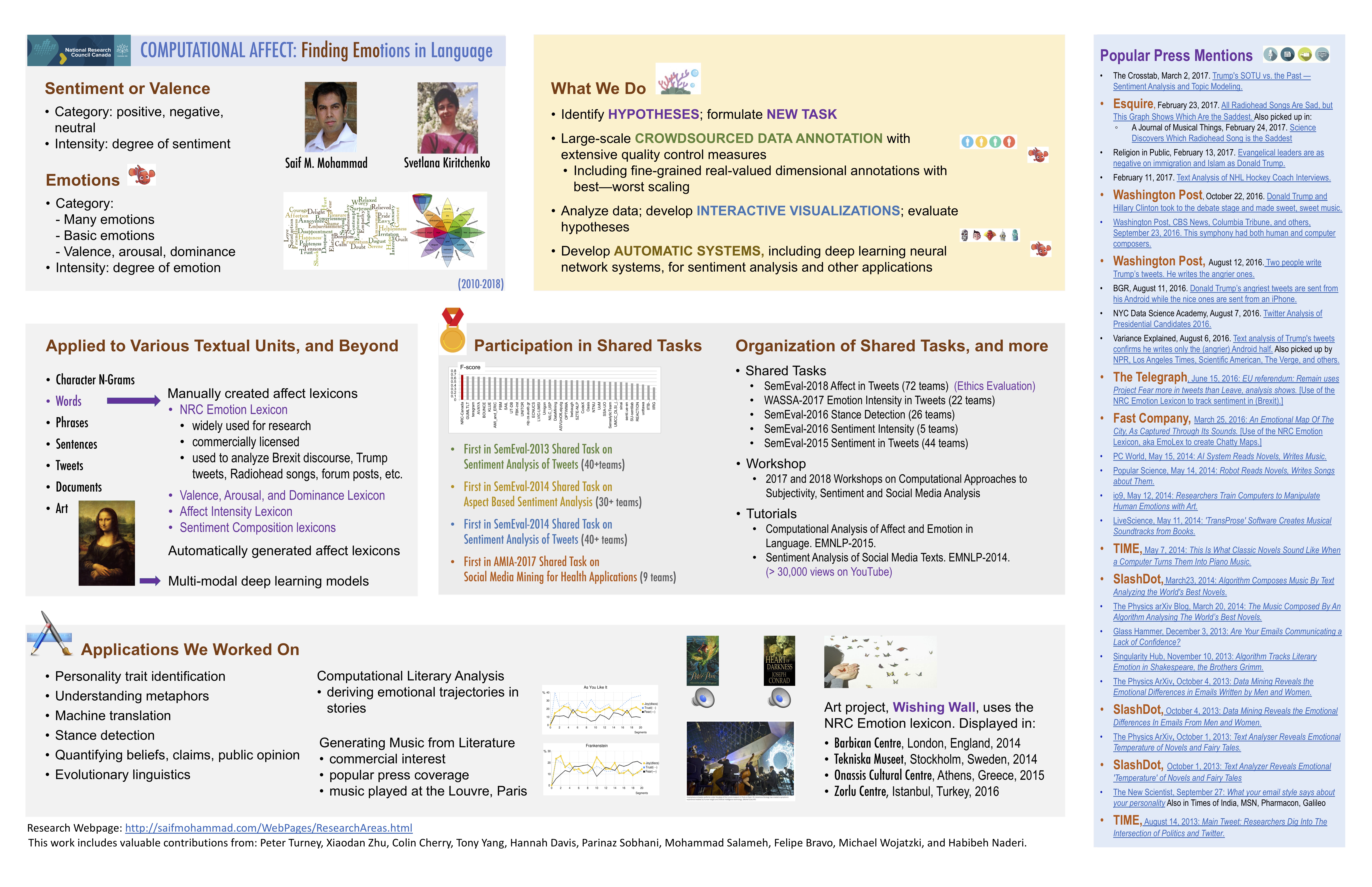
An Overview of Emotions and Language Work from 2010-2018.
Designated Contact Person:
Dr. Saif M. Mohammad
Senior Research Officer at NRC (and one of the creators of the resource on this page)
saif.mohammad@nrc-cnrc.gc.ca
Terms of Use:
-
All rights for the resource(s) listed on this page are held by National Research Council Canada.
-
The resources listed here are available free for research purposes. If you make use of them, cite the paper(s) associated with the resource in your research papers and articles.
-
If interested in commercial use of any of these resources, send email to the designated contact person. A nominal one-time licensing fee may apply.
-
If referenced in news articles and online posts, then cite the resource appropriately. For example: "This application/product/tool makes use of the <resource name>, created by <author(s)> at the National Research Council Canada." If possible, hyperlink the resource name to this page.
-
If you use the resource in a product or application, then acknowledge this in the 'About' page and other relevant documentation of the application by stating the name of the resource, the authors, and NRC. For example: "This application/product/tool makes use of the <resource name>, created by <author(s)> at the National Research Council Canada." If possible, hyperlink the resource name to this page.
-
Do not redistribute the resource/data. Direct interested parties to this page. They can also email the designated contact person.
-
If you create a derivative resource from one of the resources listed on this page:
-
Please ask users to cite the source data paper (in addition to your paper).
- Do not distribute the source data. See #6 above.
Examples of derivative resources include: translations into other languages, added annotations to the text instances, aggregations of multiple datasets, etc.
-
If you are interested in uploading our resource on a third-party website or to include the resource in any collection/aggregate of datasets, then:
-
Email the designated contact person to begin the process to obtain permission.
- After obtaining permission, any curator of datasets that includes a resource listed here must take steps to ensure that users of the aggregate dataset still cite the papers associated with the individual datasets. This includes at minimum: stating this clearly in the README and providing the citing information of the source dataset.
By default, no one other than the creators of the resource have permission to upload the resource on a third-party website or to include the resource in any collection/aggregate of datasets.
-
National Research Council Canada (NRC) disclaims any responsibility for the use of the resource(s) listed on this page and does not provide technical support. However, the contact listed above will be happy to respond to queries and clarifications.
If you send us an email, we will be thrilled to know about how you have used the resource.